Gillian - Seminar 2 Blog 1 - Research Design
‘ONTOLOGICAL BLEED’ is a research-creation masters thesis that uses the production of a database simulation game to develop experimental mechanics and a speculative fiction narrative that model and trigger the experience of ontological and ego bleed. This project investigates the affordances of the database simulation genre and multimedia narrative fragments to support this experience, developing strategies for narrative effect. Using the frameworks of cognitive and unnatural narratology, and possible worlds theory to discuss the players experience of moving from the actual world into the fictional world, discussing bleed - “In which emotions/identities/physical states/cognitive constructs spillover between player and character”(Bowman 2015; Hugaas 2024) as a form of metalepsis -” any intrusion by the extradiegetic narrator or narratee into the diegetic universe (or by diegetic characters into a metadiegetic universe, etc.), or the inverse […]” (Genette 1980; Bell 2016). The game places the player as a research intern cross-referencing databases and physical artifacts, uncovering a supernatural mystery, and interfacing with mysterious entities associated with a reality that is encroaching on our own - much like how fictional game worlds intersect with ours, with the player as pivot point, existing at once in the actual world and the virtual world of the fiction.
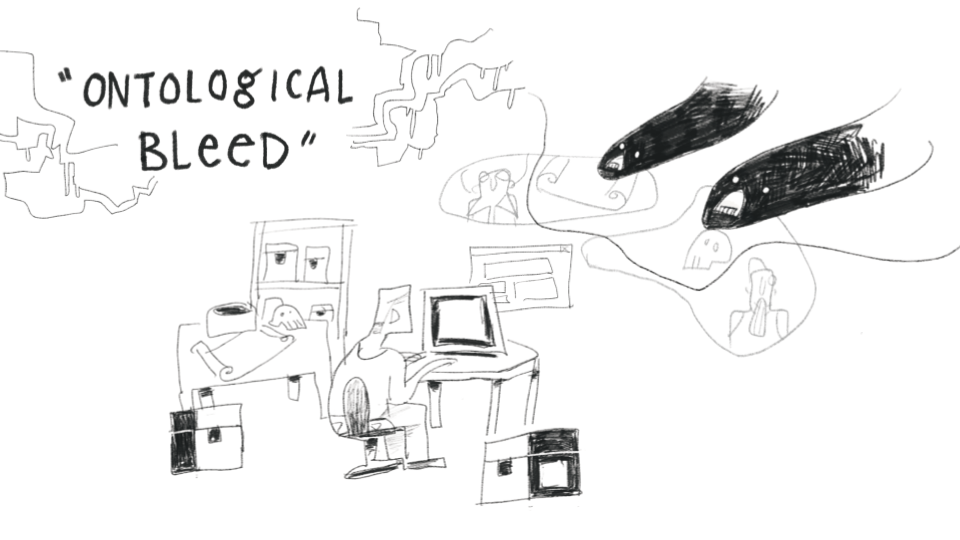
I will be exploring the affordances of the fragmentary narrative provided by the interface simulation video game genre, discovering strategies for generating the sensation of ontological and identity bleed in players, and how these methods can be used to further narrative effect. The gaps between the fragments will leave space for the player to fill in the blanks with their own identity, and invest in the fiction by making their own personalized creative connections.
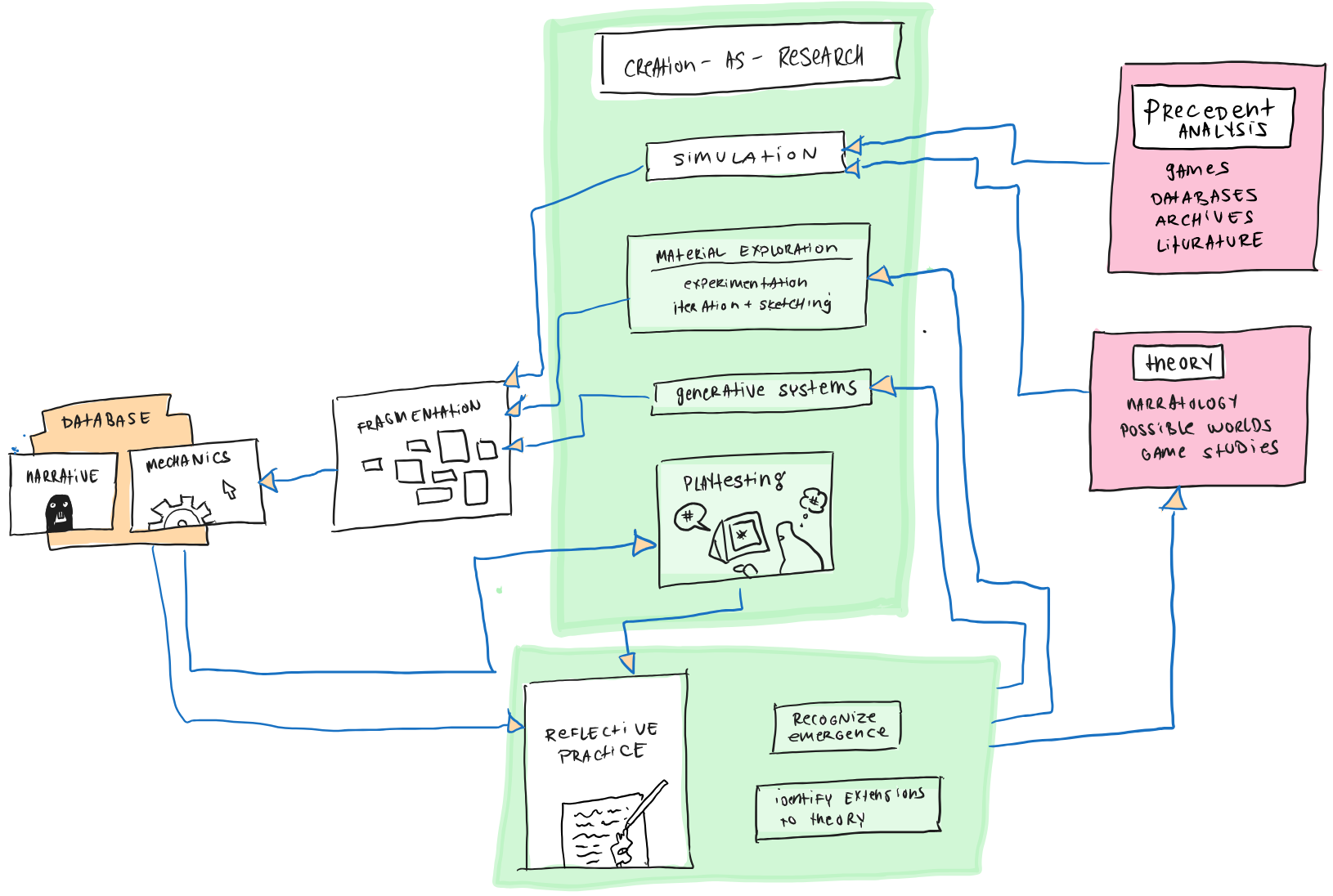
This thesis uses a mixed methodology founded in creation-as-research (Chapman and Sawchuk 2012), reflective practice (Schön 1992; Guillaumier 2016) and the iterative process (Eladhari and Ollila 2012).
Project Initiation
Contextual Review I am researching using the narratology framework initially developed by Genette (1980), contextualized in possible worlds theory and game studies by Ryan (1992), further refined to discuss metalepsis, defines as traversing the narrative<->real world barrier via interaction mechanics by Ensslin and Bell (2021). I will make conceptual connections between metalepsis and player bleed (Bowman 2015; Hugaas 2024), potentially discussing a player identity type in which players play as themselves, in contrast to the zero to three dimensional player types outlined by Alinovi (2011) as discussed by Papale (2012). I will discuss how this metaleptic bleed is made possible by the fragmentary nature of an interface database game with a physical installation and supplementary physical mechanics. This research contextualized the project, as well as providing inspiration for the mechanics and content of the game.
Words Like So Much Ivy and Immortality
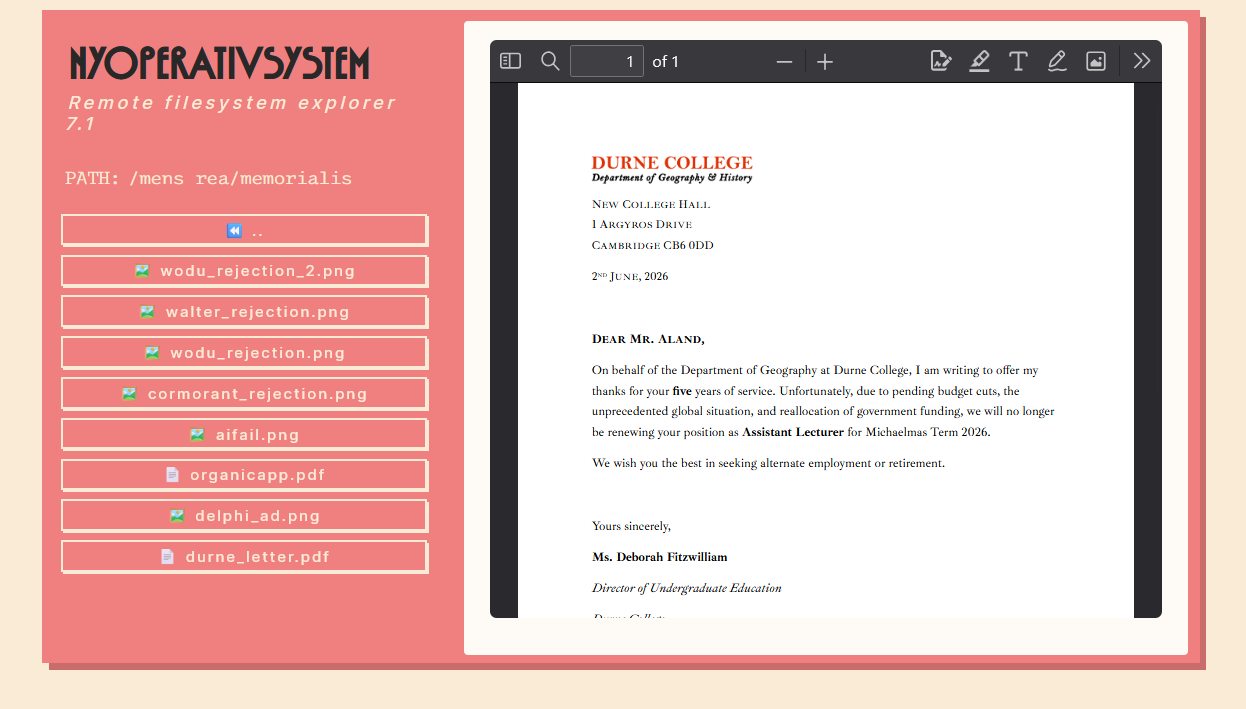
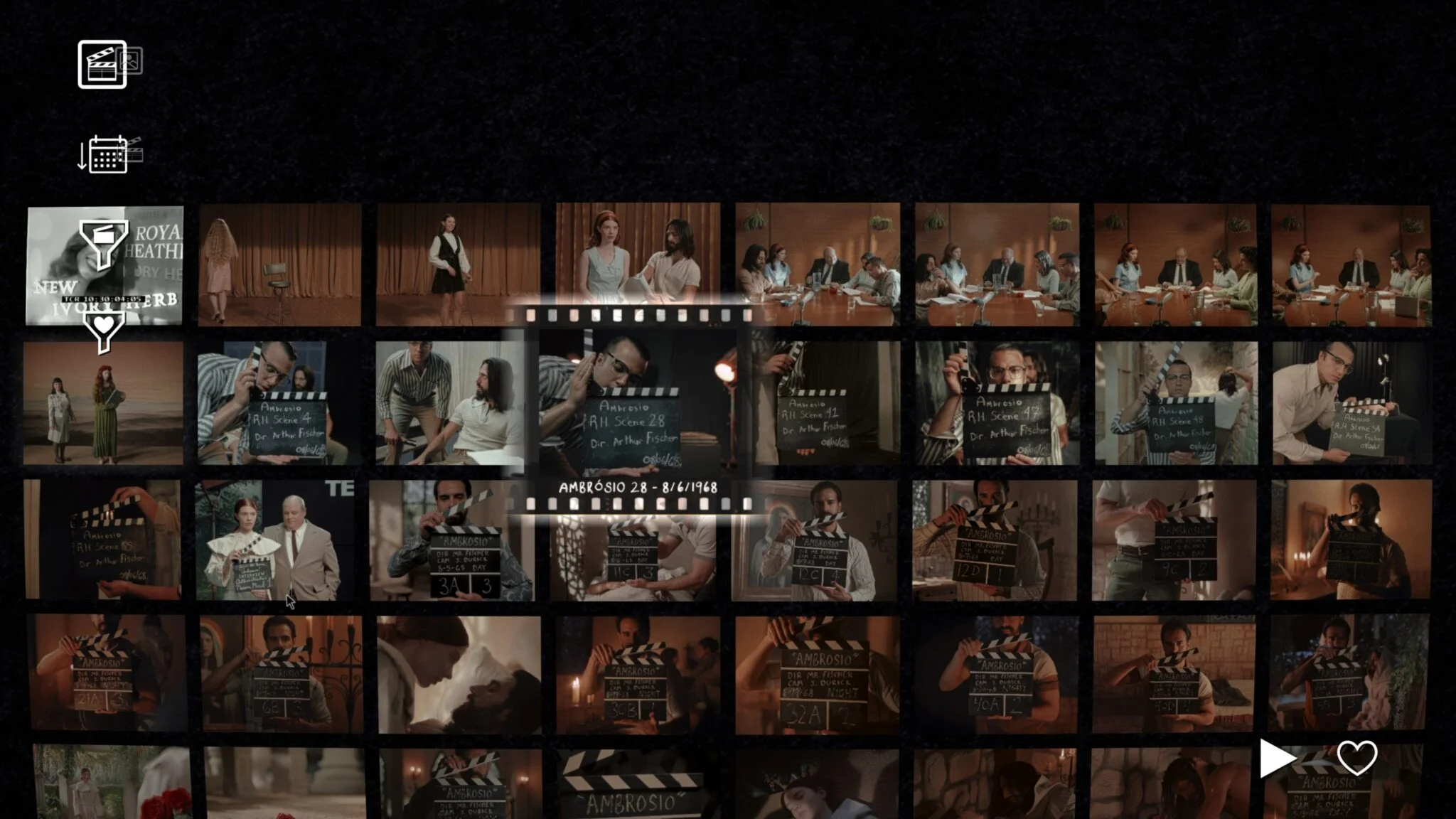
Further contextual research for the development of the research project includes a survey of existing database interface simulation games, primarily IMMORTALITY (2022), Words Like So Much Ivy (2023) and Hypnospace Outlaw (2019) and literature in which annotations become characters (House of Leaves (2000) and The Athenian Murders (2002).) I am informed by immersive installation such as He Named Her Amber (Häussler 2008). I intend to include some elements of the physical artifact creation mechanics typified in tabletop keepsake games as defined by Khor (2021). I am doing visual research into historical database software from the 1970s to present, and physical archives, to inform the design and potential mechanics of the game software.
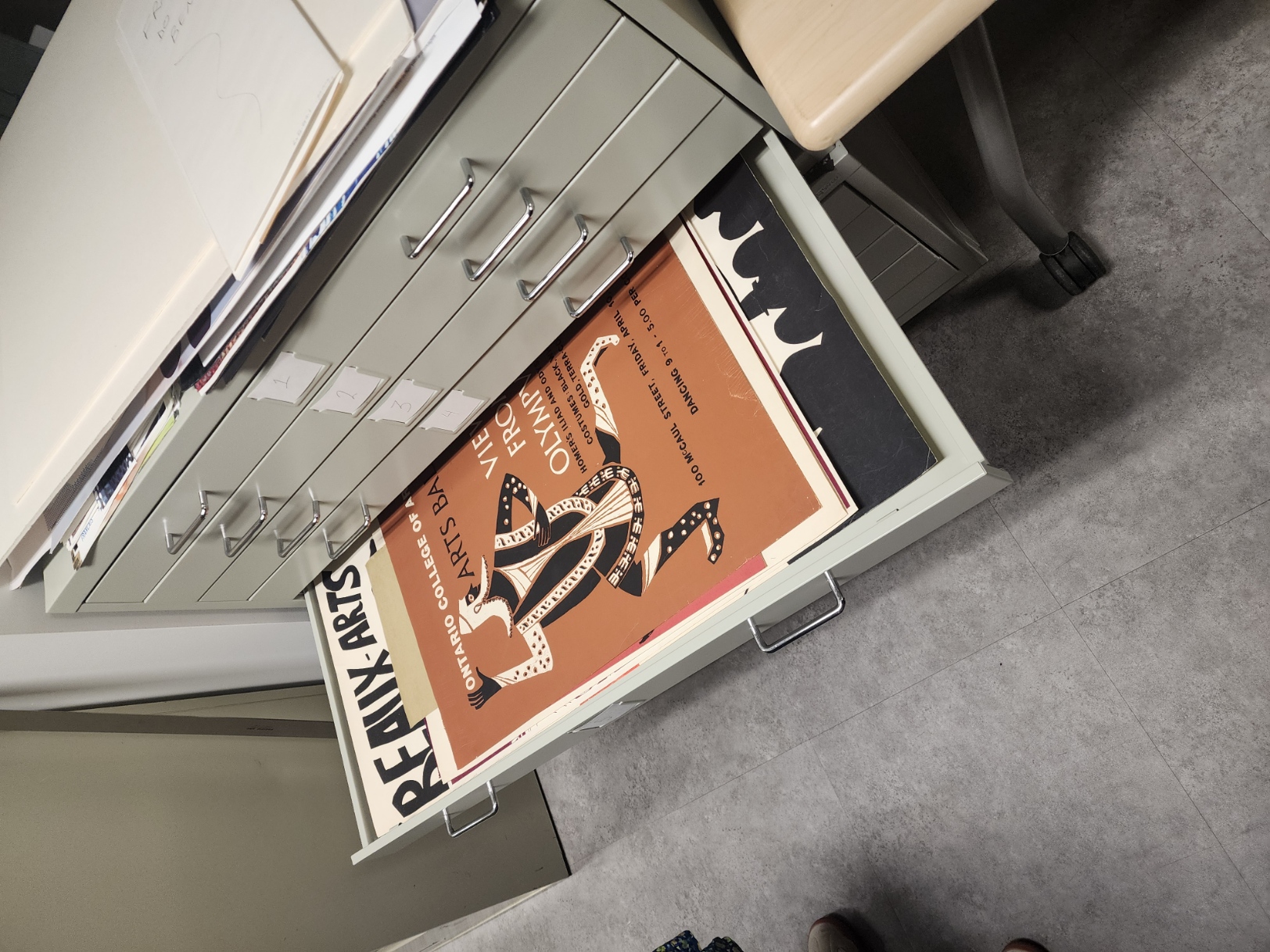
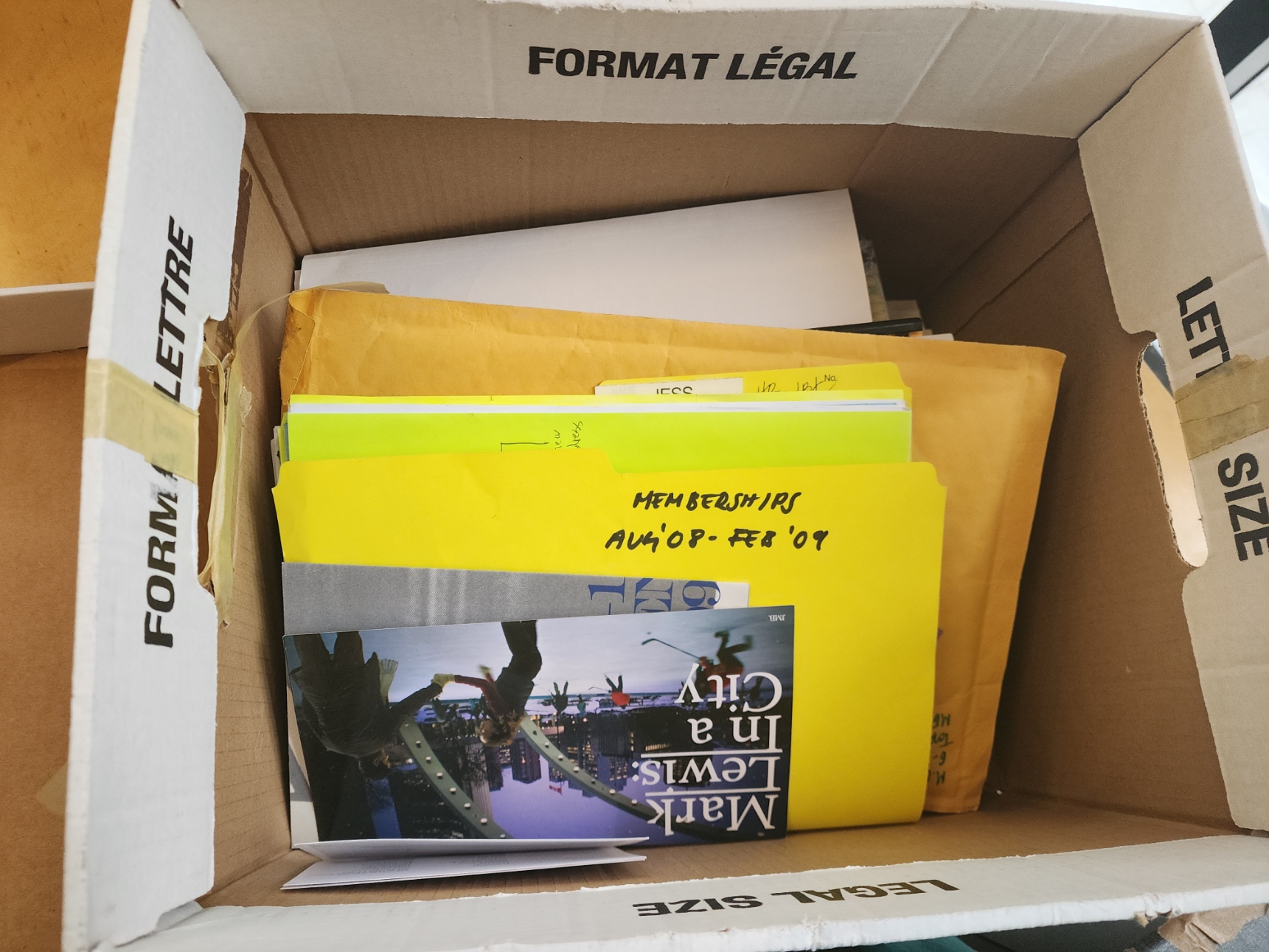
Photographs from visits to the OCADU and Interaccess archives
Engine Testing I conducted some very early tests with potential engines for use in the project, including Unity, Godot, and HTML, finally settling on using a React HTML framework with an Electron component to create a stand alone software. This engine allows for creating lightweight software that mimics the feel of contemporary database software, while still allowing it to be extended with a game state controller and mechanics appropriate to a database simulator.
Fiction development I am auditing a Technology of Writing course for inspiration of the artifacts to be included in the database. I am enrolled in a Independent Study focusing on Experimental fiction, in which I plan to develop the character and world-building aspects of the game. I've also developed an evolving tabletop game help with generating potential story fragments.
Project Design
REB Application An application has been sent to the Research Ethics Board for approval to test to playtest the project with human participants throughout the project, and survey their understanding and emotional reactions to playing the game. Data will be collected by recording play sessions through audio, video and screen recording, as well as collecting telemetrics data and having players fill out exit surveys. This data will be taken from both in person and remote playtests, with players submitting their own recording data via the exit survey. I am also requesting permission to ask participants if they would like the physical artifacts they produce as part of the playtests and exhibition back into the content of the project.
Workback schedule An evolving schedule for prototype deadlines, outlining the mechanical, narrative and conceptual outcomes of each have been designed around academic deadlines throughout the semester.
Game design document The design document outlines the technological affordances revealed by early prototyping, and speculates at the mechanics can can be developed around those affordances. It solidifies game design pillars and provides an early outline of narrative content. This document focuses on the technological and narrative components of the project.
Thesis Proposal A proposal focused on the conceptual and methodological frameworks underpinning the project.
Project Development
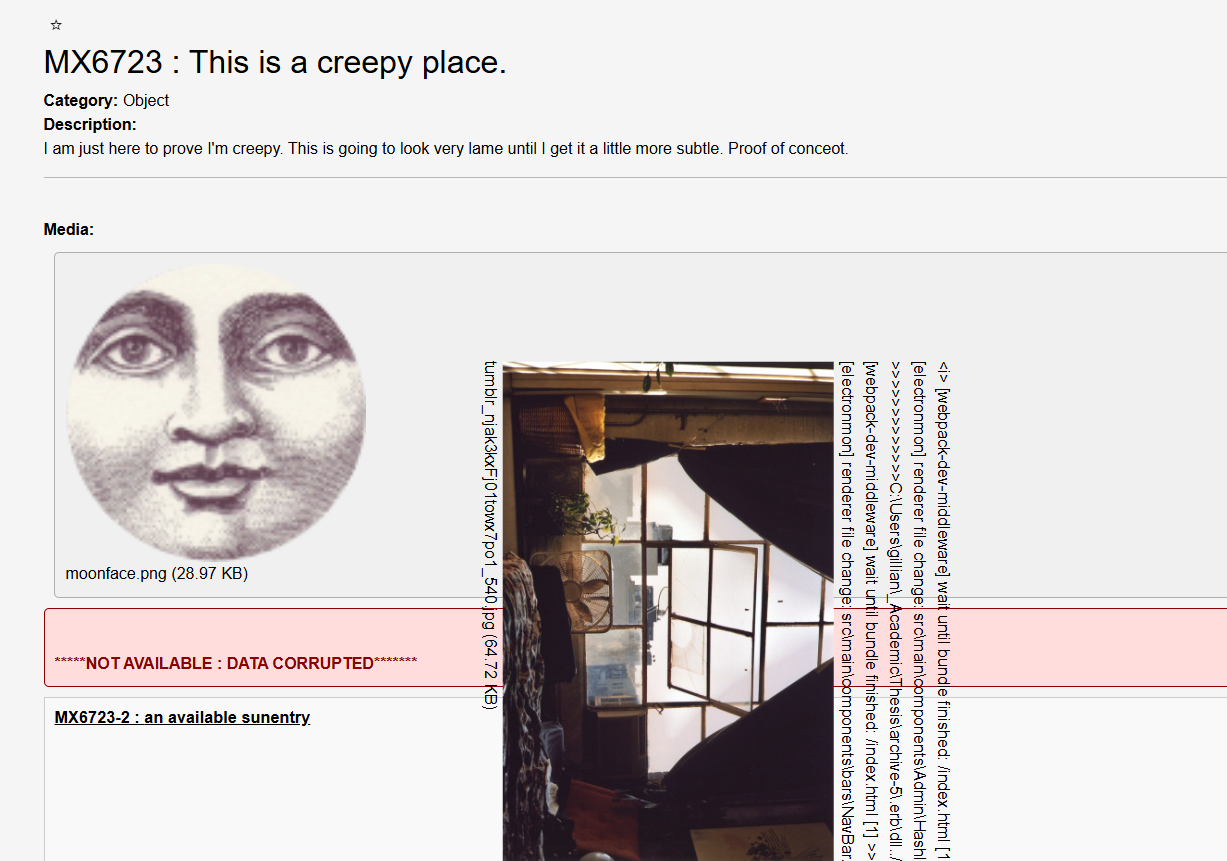

Iterative Prototyping I am producing a series of database prototypes in React, I am currently on version 0.6. On REB approval, these prototypes will begin to target specific narrative, mechanical and conceptual goals, and be released for playtesting.
Literature review A partial annotated bibliography has been written, this is to be adapted for into a lit review for the research paper.
Artifact and installation prop procurement I am currently searching for and purchasing props to include in the physical installation and document in the database software.
Artifact fabrication A few key props will be fabricated for inclusion in the database. The majority of these props will be false documents, modelled after the different time periods in which they claim to be from. A select few will be sculpted evidence of the supernatural incursion, to which the false documents will refer. The false documents will also hint at artifacts that have been lost due to archive degradation.
Development blog Excerpts from the research notes are being published online as a development blog for the project, as an artifact of reflective practice. This includes photographic and screencaptured documentation of the development process, written reflections on research and development, and illustrative diagrams of conceptual reflections, and visual research images.
Data collection and analysis Data from the playtests and exit surveys will be reviewed and their findings used to inform future prototypes and reflected on in the research paper and development blog. The majority of the data will qualitative, but some data numerical rating data will be analysed in graphs, and a heatmap of common wordage in the exit surveys my be designed.
Project Delivery
In person playtests Playtesting sessions will be conducted, primarily at OCADU, with recording set up to capture data. The intended sequence of the playtests will test for the following:
* Navigation and UI ease of use
* Narrative understanding and immersion
* Physical and digital mechanics tests
* Immersive Installation tests
The immersion installation playtest will also hopefully include an actor playing the role of one of the researchers, to record video logs of their discoveries in the archive to be included in the database.
Remote Playtests Playtests, excluding the immersive installation playtest, will simultaneously be conducted remotely and asynchronously by recruiting playtesters and providing the software and exit survey online.
Exit Surveys For each playtest prototype released, the exit survey will be updated to test for specific data.
Project Output
Public exhibition The thesis exhibition includes an immersive installation simulating the archive, featuring the physical artifacts, an analogue file system that has been “partially digitized”, and a version of the database software presenting a limited glimpse into the narrative that will be less challenging to navigate in a public setting.
Small press video game The full digital version of the game will be released in itch.io.
Zine A short zine, fashioned to be an employee onboarding manual will be produced and distributed as part of the public exhibition, and at future games and comics festival. It will outline "volunteer employee responsibilities" for working with the archive, include blank pages for note taking and some of the physical mechanics, and will include a link to the in-world organization website to download the archive software.
Research paper The thesis paper, outlining the findings of the data collection and reflecting on the exploration and design process will be published to the OCADU repository.
Development blog A blog published online with freeform documentation of the development process and research findings is being updated during development and will be hosted for as long as is practical.
Illustrative diagrams and sketches Part of the research process includes illustrations to process revelations of the contextual review and design process. Select illustrations will be included in the research paper, with more appearing on the development blog.
Artist talks I intend to apply to give talks about the development of the game or findings from the research at festivals and conferences.
Tabletop game The mechanics of the tabletop game created to assist in story generation may be polished and generalized for eventual release as a stand alone game.
Bibliography
Alinovi, Francesco. 2011. Game Start! I Blu. Springer Milan. https://doi.org/10.1007/978-88-470-1956-0.
Bowman, Sarah Lynne. 2015. “Bleed: The Spillover Between Player and Character.” Nordic Larp, March 2. https://nordiclarp.org/2015/03/02/bleed-the-spillover-between-player-and-character/.
Chapman, Owen, and Kim Sawchuk. 2012. “Research-Creation: Intervention, Analysis and ‘Family Resemblances.’” Canadian Journal of Communication 37 (1): 5–26. https://doi.org/10.22230/cjc.2012v37n1a2489.
Eladhari, Mirjam Palosaari, and Elina Ollila. 2012. “Design for Research Results Experimental Prototyping and Play Testing.” Simulation & Gaming 43 (3). https://doi.org/10.1177/1046878111434255.
Ensslin, Astrid, and Bell, Alice. 2021. “Interactional Metalepsis.” In Digital Fiction and the Unnatural: Transmedial Narrative Theory, Method, and Analysis. Ohio State University Press. https://www.jstor.org/stable/jj.12250637.
Genette, Gérard. 1980. Narrative Discourse: An Essay in Method. Cornell University Press.
Guillaumier, Christina. 2016. “Reflection as Creative Process: Perspectives, Challenges and Practice.” Arts and Humanities in Higher Education 15 (3–4): 353–63. https://doi.org/10.1177/1474022216647381.
Hugaas, Kjell Hedgard. 2024. “Bleed and Identity: A Conceptual Model of Bleed and How Bleed-out from Role-Playing Games Can Affect a Player’s Sense of Self.” International Journal of Role-Playing, no. 15 (June): 15. https://doi.org/10.33063/ijrp.vi15.323.
Shing Yin Khor. 2021. “On Keepsake and Connected Path Games.” Blog. Patreon, February 15. https://www.patreon.com/posts/on-keepsake-and-47599952.
Papale, Luca. 2014. “Beyond Identification: Defining The Relationships Between Player And Avatar.” Journal of Games Criticism 1 (2). https://gamescriticism.org/2023/07/24/beyond-identification-defining-the-relationships-between-player-and-avatar/.
Planells de la Maza, Antonio José. 2017. Possible Worlds in Video Games: From Classic Narrative to Meaningful Actions. Carnegie Mellon University ETC Press.
Ryan, Marie-Laure. 1992. Possible Worlds, Artificial Intelligence, and Narrative Theory. Indiana University Press. https://iupress.org/9780253350046/possible-worlds-artificial-intelligence-and-narrative-theory/.
Schön, Donald A. 1992. The Reflective Practitioner: How Professionals Think in Action. Routledge. https://doi.org/10.4324/9781315237473.
Mediography
Barlow, Sam and Half Mermaid, dirs. 2022. IMMORTALITY. Interface Simulation Game. Half Mermaid. PC. https://store.steampowered.com/app/1350200/IMMORTALITY/.
Danielewski, Mark Z. 2000. House of Leaves. Pantheon.
Häussler, Iris. 2008. He Named Her Amber. Hyperrealist Installation. https://haeussler.ca/projects/amber.html.
Prang, Chris, dir. 2023. Words Like So Much Ivy. Self Published. PC Game. https://aulddaegs.github.io/drive/index.html.
Somoza, Jose Carlos. 2002. The Athenian Murders. Abacus.