g blekkenhorst | october 2025
Introduction
To pursue answering my research questions, I am developing a mixed methodology based in creation-as-research [@chapmanResearchCreationInterventionAnalysis2012], and reflective practice [@guillaumierReflectionCreativeProcess2016; @schonReflectivePractitionerHow1983] , and an adaptation of the iterative process [@macklinGamesDesignPlay2016].
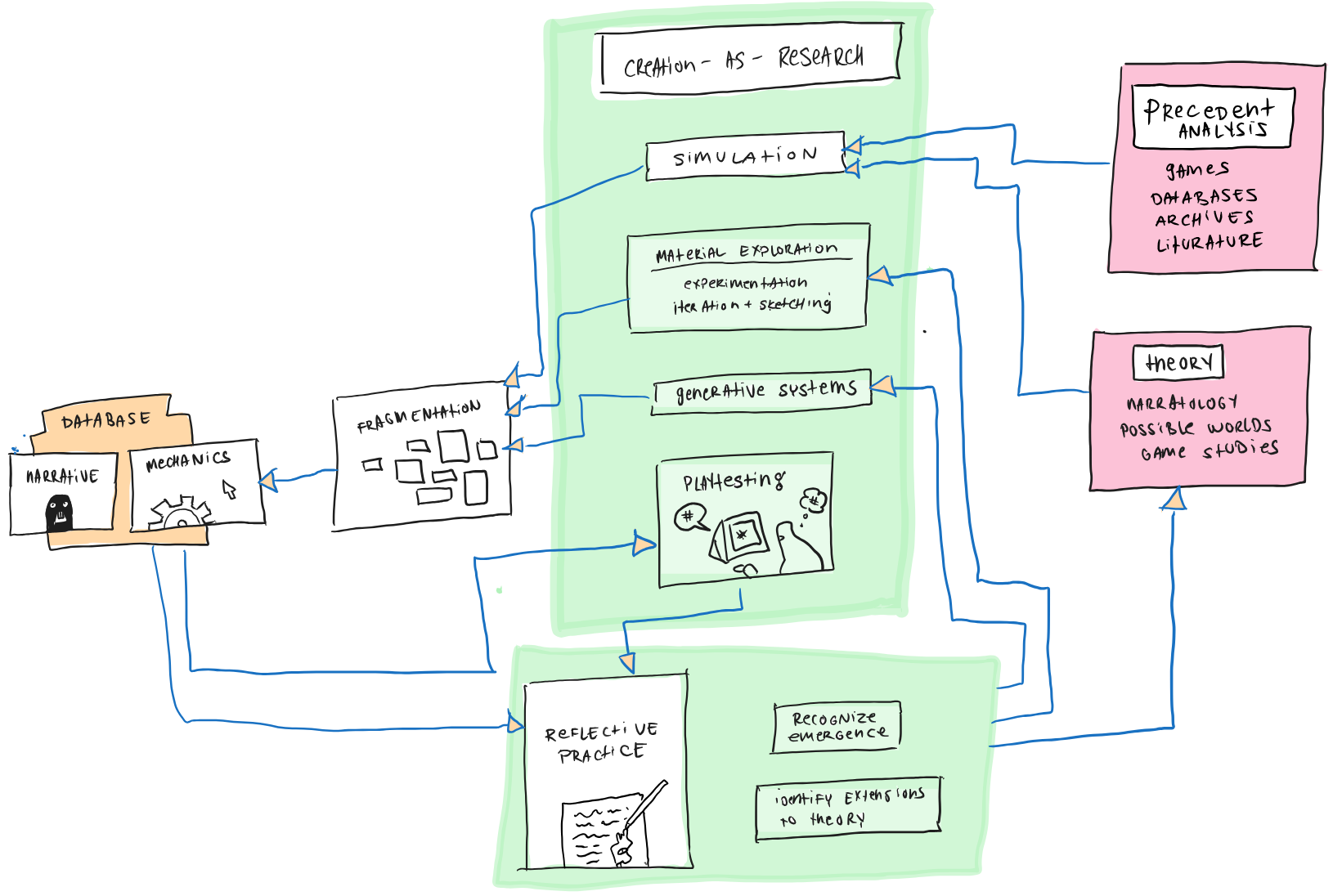
Creation as research
The creation-as-research is set around a creation project - a narrative game created through a physical archive installation and the digital database software that indexes it. The game is designed to simulate or invoke concepts from a theoretical framework, and through the methods of material exploration, iterative prototyping, and reflection[1], capture emergent affordances that may grow alongside with these elements.
Literary Review
I'll be conducting a review of literature related to interactional convergent metalepsis, using the language of possible worlds, and it's relations and overlap with the phenomena of bleed. I am delving into these areas of research with the specific intention of eluding to them in the fiction, simulate them in the mechanics, and invoke in the experiences of them in the player. My intention is that by using these concepts as pillars of my design, I will see how these concepts interact with each other when given tangible form, and what may emerge from a system designed to do this.
I'll also be reviewing some literature related to physicality and tangibility as a contrast to purely digital experiences, to find language to describe the sensation I wish to discuss, and see if there is inspiration for potential gameplay mechanics within it. The tangibility aspect is included to see how it can support bleed and metalepsis - to see if drawing the digital fiction out into the physical through the inclusion of physical artifacts, and their representation within the digital assets, helps people feel as though they are bridging the real world and the game world. The fiction will further refer to this idea of matter being translated from one dimension to another and beings changing as they cross between them.
Further research into narrative fragmentation will help shape the mechanics of the annotated database.
I am hypothesizing a few things I hope that will grow within a game seeded with these concepts - people playing as themselves, people feeling they become an intersection between worlds, people feeling that are being hijacked, people feeling like they are taking part of that world with them and leaving part of themselves behind - while being open to other emergent experiences.
The purpose of this review is to become familiar with the current state of discourse in these areas, and imagine ways that they can be represented within the research project. Then, to contextualize any findings that may arise from the development back within the frameworks they were inspired by.
The methods for this review include traditional reading, writing, and citation, but I am also using illustration to further understand the concepts, by citing examples from related media, through drawing, and through attempting to represent the theory within the game itself.
Precedent Analysis
I'm using other fictions within my literary review to illustrate the narratological concepts I am exploring - not to suggest they were designed with that intent, but as examples of how such a thing could be executed. I'll also be conducting critical readings of related media to see how the authors and designers achieved different narrative and experiential effects, with an eye to see if there are any techniques that would be suitable for my game.
Further media research includes examining how media, especially archive media, degrades over time, and how this can be used both to imply lost content, and allow for horror elements as the database becomes destabilized. The design of the database and the artifacts will be informed but not limited by research into software and artifacts from similar time periods. I am visiting archives, interviewing archivists, and researching collections to see how these systems are often set up to inform my own.
Material Exploration
While I do have a defined workflow for prototyping, it has been designed in a way to specifically leave gaps for the emergent properties of the materials I am using. The fragmentary nature of the project allows for many tiny experiments in a variety of media. The hope is to discover aspects of the project and the fiction by allowing the conceptual framework and eventual design and narrative goals to marinate, while seeing how they may be captured in the various objects I make.
I am exploring physicality and tangibility - some of my materials are physical, and I am deliberately trying to reflect the physical in the digital and draw attention to this fact by referencing it in the fiction. I am looking for the exploitable affordances of these narrative media. My artistic background is very interdisciplinary, and I will see what opportunities I can find to further simulate my theoretical concepts. I want to make the things I like to make - fake documents, sculpture, little mechanical contraptions. And these objects are indexed primarily by a software that is built in code, and this code is a material, too. In building the software I am sculpting with code.
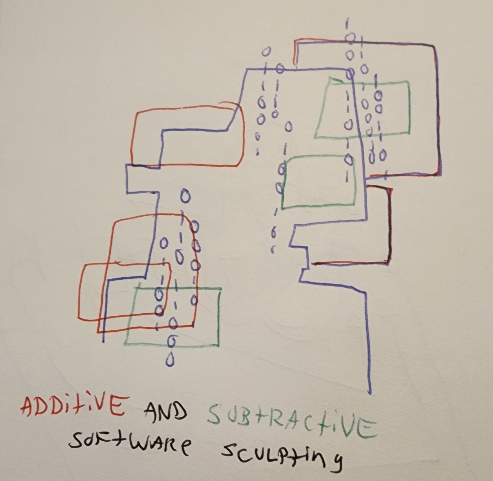
Generative Systems
Making your own tools
Part of my process is to develop tools to think through. The thought is shaped by the box it is born in, so it is as important to design the box as it is to design the thought. I am considering the end product of this experimentation to be the player experience, rather than the software or the installation themselves.
The software is crafted so that the same code base is being used for interface displayed to the players, as well as for me as the writer.
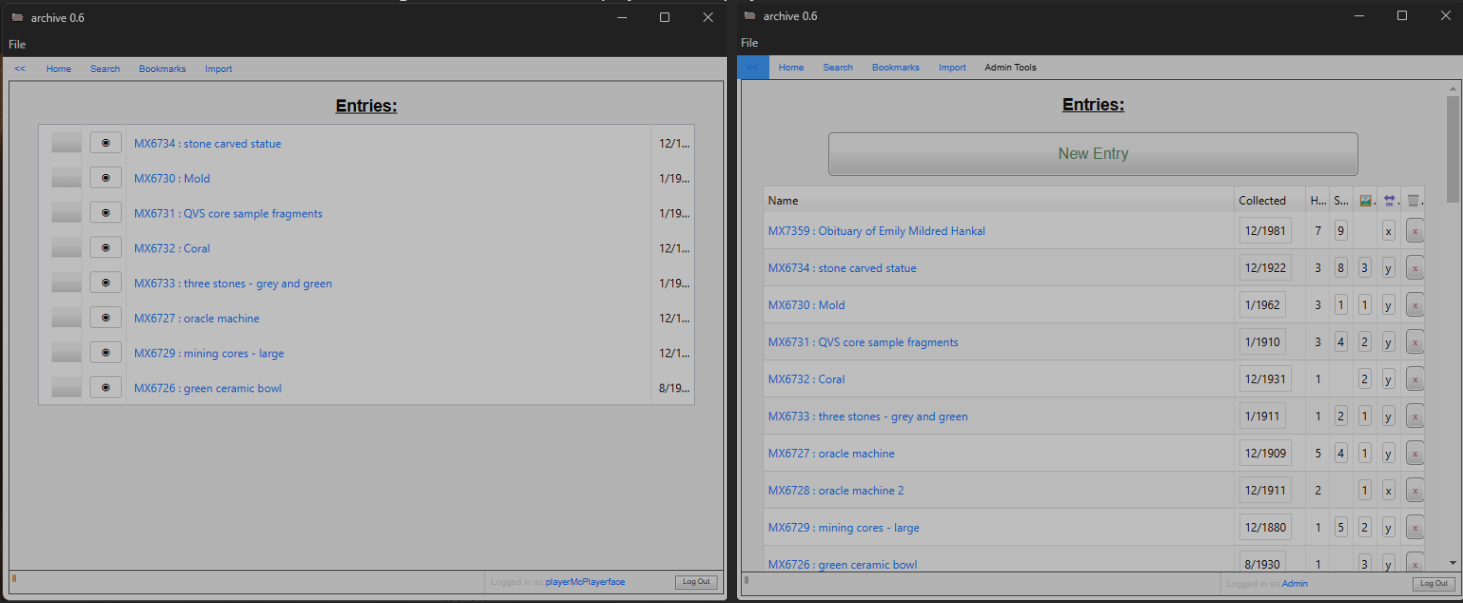
The software is designed to be fragmentary for the player, and I've found it's suited my workflow to allow for the writing to be fragmentary as well. I have developed a web version so I can write on my phone, wherever I am. This is a way to capture fragments as they fall. The software shapes the story, not just how it is framed for players, but how it is framed for me as I am writing it. I am designing a workflow where I am building the story and the software on top of each other, they are co-evolving alongside each other.
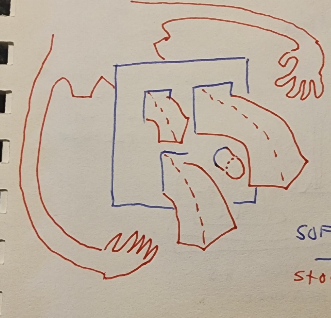 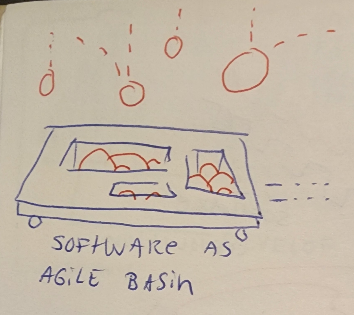
Later I will go into the software and housekeep, generating more connections and culling fragments that don't work. Always leave gaps for players. [2]
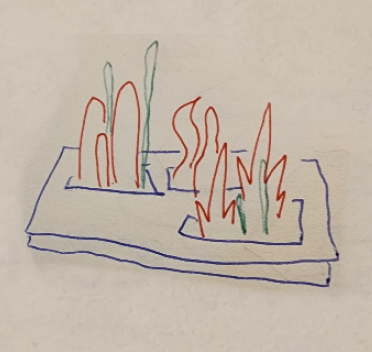
If I am building a software that I think will support certain seeds, I want to build it and see what else grows there. If I am developing a ecosystem to support a specific kind of life - a horror story, a story about other worlds, a story about bodiless voices and voiceless bodies, about identity and technology. As I build this place, I will see what elements need to be added to support the life I wish to cultivate, and I will write it down. And I will watch if what I seeded grows, and what else finds a home in my garden anyway. And I will write it down.
I am also creating side prototypes of generative systems to assist with sifting data and generating emergent connections as I go. Examples of this include pages of the software that are only accessible in administrator mode, so data can be displayed and edited in different formats, and a tabletop game of different design aspects to randomize potential story elements and materials.
Prototyping
Structure of development
I work best in short, furious bursts rather that on a cycle of polishing and refining longer projects. I've conceived of undertaking this project as though creating a series of short, sharp prototypes - that happen to build on each other and grow in the same software. It still ends following the iterative process, in that the mechanics and features of each stage become expanded on and refined throughout iterations[@macklinGamesDesignPlay2016]. However, my design and reflection phases involve returning to and potentially expanding my contextual review, and I consider each of my playtest prototypes to be their own ephemeral performances.
Iterative Process
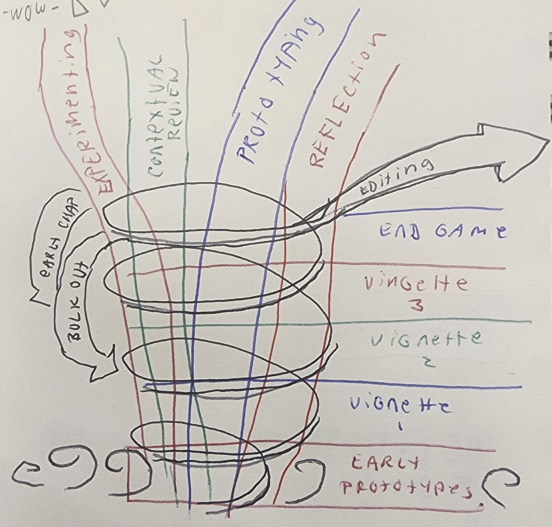
Scattered along the bottom of figure 7are my prototype sketches. But they are not abandoned, they are crystalized forever in my development blog, as well as in myself, the things I learned from them.
My prototyping method involves started many little prototypes - to sketch a thumbnail or write a phrase, or fabricate a feature quickly and self consciously. To start and scrap and start and scrap until my muscle memory learns to draw a line with the right weight, the first time.
I take one promising prototype to continue with as the foundation to continue with, although I am willing to abandon it at any moment if I need to and take the lessons it taught me onto a clean canvas.
I will continue stepping away from the primary prototype to sketch new features and experiment with new techniques, taking these sketches back into the main prototype when the are ready.
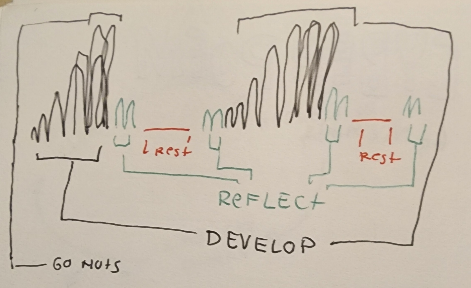
For wellness, I need to build in breaks after each burst so I don't burn out. After each deadline I will take time for written reflection, and an early list of potential tasks and explorations to undertake next round, and securing documentation media and playtest results for later analysis and editing. After the rest, I will revisit these materials and prepare for the next development cycle.
Vignettes
Each stage of development is being referred to as a "Vignette", and approached as a short story within a larger fragmentary fiction, that both inform each other but can stand alone.
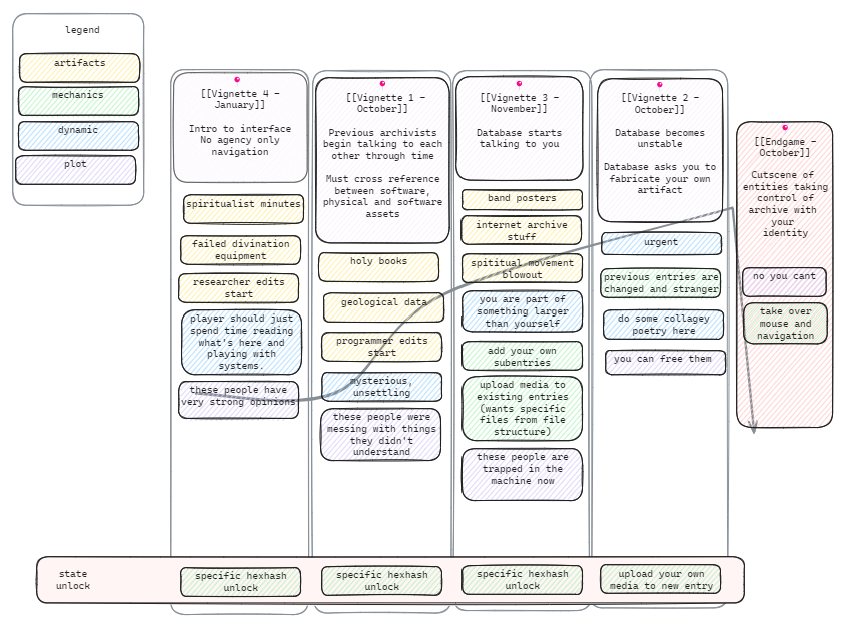
These vignettes are scheduled throughout the academic year, and each one is designed around the theoretical concepts they are intended to simulate, as well as the narrative and mechanical elements they should include. Each vignette will also have a small selection artifacts that have have been physically fabricated, as well as mundane objects that are augmented, not necessarily physically, but by the narrative spun around them within their database entries.
Playtesting and research participation
Playtesting will involve two versions - a series of in-person playtests, which will involve having the current database software showcased within the archive installation, as well as a remote-playtest version with small adaptations to skip past content requiring the physical installation.
In person playtests will be conducted primarily at OCADU in conjunction with my cohort. Video and screen recording, and in-software telemetric will be set up but can be paused for players who are not qualified to participate, or participants who would prefer not to have this data collected. Because of the nature of the vignettes to evaporate into the next as production continues, and each installation will vary depending on the needs of the vignette and the considerations of the venue, each in-person playtest is it's own discrete artwork, rather than just a means to test an eventual end[3].
Remote playtests will be conducted through a website, set up to screen participants, collect consent forms, provide the software, and link to an exit survey to collect player data. The exit survey will allow remote playtesters to attach their own play recordings, and answer questions about their experience.
Participants will recruited through the playtesting events, as well as through notices on social media and word-of-mouth. I'll have a mailing list set up to provide to interested participants.
The gameplay will involve participants typing things into the software and generating physical artifacts - their own "research notes" from their time in the archive, and a physical artifact crafted however they like, to add to the archive. The archive is not networked or multiplayer, but with the participants consent, I'm hoping to incorporate some of these generated elements, both digital and physical, back into future iterations. I want to write the world around the people who have played it, having them leave pieces of themselves behind (and hopefully take some of it with them, in their hearts and in their pockets - I am going to make a diegetic zine.)
The playtests will function to find bugs in the software and installation design, to provide deadlines for each vignette, generate new artifacts, and to collect data from consenting research participants to be analyzed for emergent conceptual and narrative properties of the gameplay. REB approval is pending for this third consideration.
The surveys will be kept open ended - the software is fragmented, to allow narratives to twist inside of its audience and be tinged with their own being. I want to capture these stories and reflect on them, and incorporate their potential back into the project.
Reflective Practice
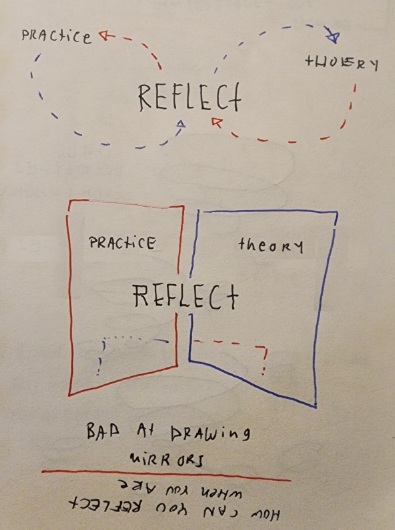
My methodology uses reflective practice as reflection-in-action[@schonReflectivePractitionerHow1983] through the material exploration, through multimedia artifacts and the material of game mechanics - being present and paying attention to how the material behaves, and learning what it can do. It involves reflection-on-action[@schonReflectivePractitionerHow1983], looking back over recent experiences and processing them. I'll do this through free-writing, drawing and diagramming. Drawing is an essential method for me to work through understanding of the theoretical concepts - to create spatial relationships between topics, and to narrativize their relationships.
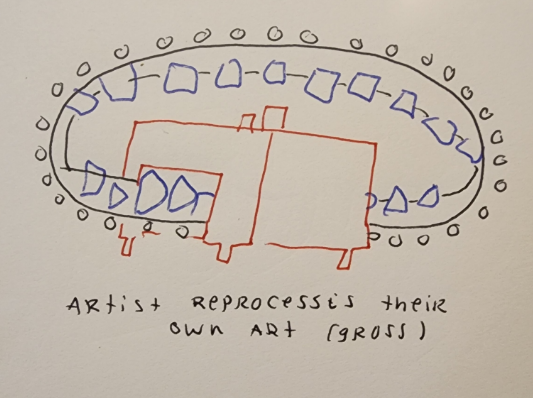
The purpose of this reflective practice is more than just making value judgment about whether an experiment achieved a successful outcome, or to survey for weaknesses that can be diagnosed and addressed, but to build a foundation for recognizing and reacting to emergence. It is the hope of this project that by simulating the abstract in a tangible material, the properties that emerge within that simulation may be nurtured and contributed back into theoretical discourse.
I am also a relentless documentarian of my own processes. My innate tendency is to hoard and archive evidence of my own agency, I came into this project with workflows in place to capture this data. Refining and editing this documentation to share at various stages of the academic process has allowed me to reflect on the process. This data includes written reflections, screenshotted and photographic documentation of the installation and software as they evolve.
Discoveries relation to the initial research questions will be further discussed and analyzed in this research paper, but the reflection in its entirety will be collected in an online development blog. This blog is aggerated directly from my notetaking software, where they can be tagged and cross referenced to find patterns and generate new knowledge. Part of this reflection is informed by “learning in public” [@wangLearnPublic2018] and “digital gardens” [@appletonBriefHistoryEthos2021] - concepts from the software development community, dedicated to sharing community knowledge as an evolving work-in-progress.
Conclusion
This mixed-methodology approach, and the methods it umbrella, are already an extension of my existing practice - I seek to adapt narratives into mundane systems, and here I am adapting my existing workflows into an academic year, to work with academic considerations. The major changes to my normal processes are that my research is grounded in academic discourse rather than my usual rats nest of bookmarked news articles and wikipedia entries, and that I am pushing myself to share my works in progress with the world at every stage, instead of sitting on everything until it is finished or abandoned. In choosing to contextualize my players as research subjects, I am learning to integrate an eventual audience earlier in the process, which invites them to participate in the process as part-authors in a way which I have only started experimenting with this past year.
The stepped-vignette method to iteration is also new to me, and I'm excited to see if it works. I've never pursued a project that would take quite this long to complete, and this design consideration is to make sure I stay interested and rewarded, while not letting my perfectionism spiral out of control or my tenacity to burn me out.
This methodology will allow me to answer my research questions into the effects of physicality and fragmentary database simulation of the phenomena of metalepsis and bleed.
Is there a good way to phrase this to include both MY reflections on my experience, and my players reflections on their experiences that they share with me? ↩︎
I think these diagrams are probably silly and it's not helpful to have so many is such a short section, but I'm keeping them in for now. ↩︎
Is there a better term I can use than "playtest"? It doesn't feel right. And I am using the term "installation" to mean the portion of the experience in which physical set dressing is used to extend the world, so I don't want to use that word to describe these events. ↩︎