literature is a machine for producing possible worlds
Recently I came across Umberto Eco saying a "literature is a machine for producing possible worlds" and I have been thinking about that a lot!
He also calls them "lazy machines", in that they require the user to do most of the work to create the final product. Any machine I use is augmented with spare parts from the last fifty machines I picked up, and whatever childhood traumas I have lying around.
I think that when I am playtesting, it should be less about trying to perfect if I am being understood, and more cultivating
curiousity about what stories people are using my lazy machine to generate. I don't know if that shows a failure of academic rigor. I am probably supposed to be testing a hypothesis. Probably that only matters depending on who I am trying to impress? Only an imaginary god and the hypothetical person who wants to pay me to keep thinking my little thoughts.
I saw Pontypool tonight with a director Q&A and asked about a scene I loved in the film, but the director didn't give us an answer we liked so we've decided it's not canon. In our Possible Pontyworld. I have my Pontyworld, director has his Pontyworld, writer has his Pontyworld, Trevor and Mary have their Pontyworld and we agree but only so far as we can communicate our interpretations. Mazzy and Sydney have their Pontyworld. Sat in a room full of people generating Pontyworlds and bubbling them out into the atmosphere. I spit out a different Pontyworld the last dozen times I watched that movie, mucked up and mediated by whatever other media I had drifting around in my nervous system at the time.
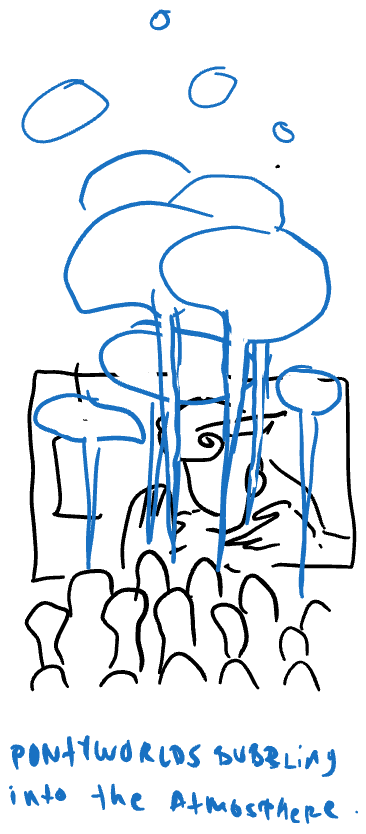
Is there more to a video game as a possible worlds machine because you have some agency about expressing your interpretation in a tangible way? Yes, obviously. Maybe the variations also get wider, but I think not as much as some would argue, if you think a static text is actually static. Maybe even that possibility space is smaller, because of us needing to keep our dreams inside of the systems provided to us? (I don't really believe this, I'm just saying it in case you're thinking it.) Me misinterpreting a song (because I willfully ignored half the lyrics that didn't work in the narrative I used it to tell myself) was a seamless process. I never walked up to a short ledge I couldn't jump over. And I didn't notice that I told myself different stories with that song at different times, until I lined them all up to tell to another person. But really, I am just as willing to ignore the systems that don't serve me in a game as I am in a poem[1]. The systems become their own kind of modality, like how a poem can change with a musical score, a poem can change when I need to earn the next part. It adds a meaningful emotional variation. I don't know where I'm going with this.
In Riven, I am a creature with no knees, and linking books show me a fourth dimensional overveiw of an Age and all its interconnected systems from microbes to star systems in my understanding, not in a tiny QuickTime rectangle. This was canon and seamless until I met someone who didn't make the same assumptions. ↩︎